相关简介
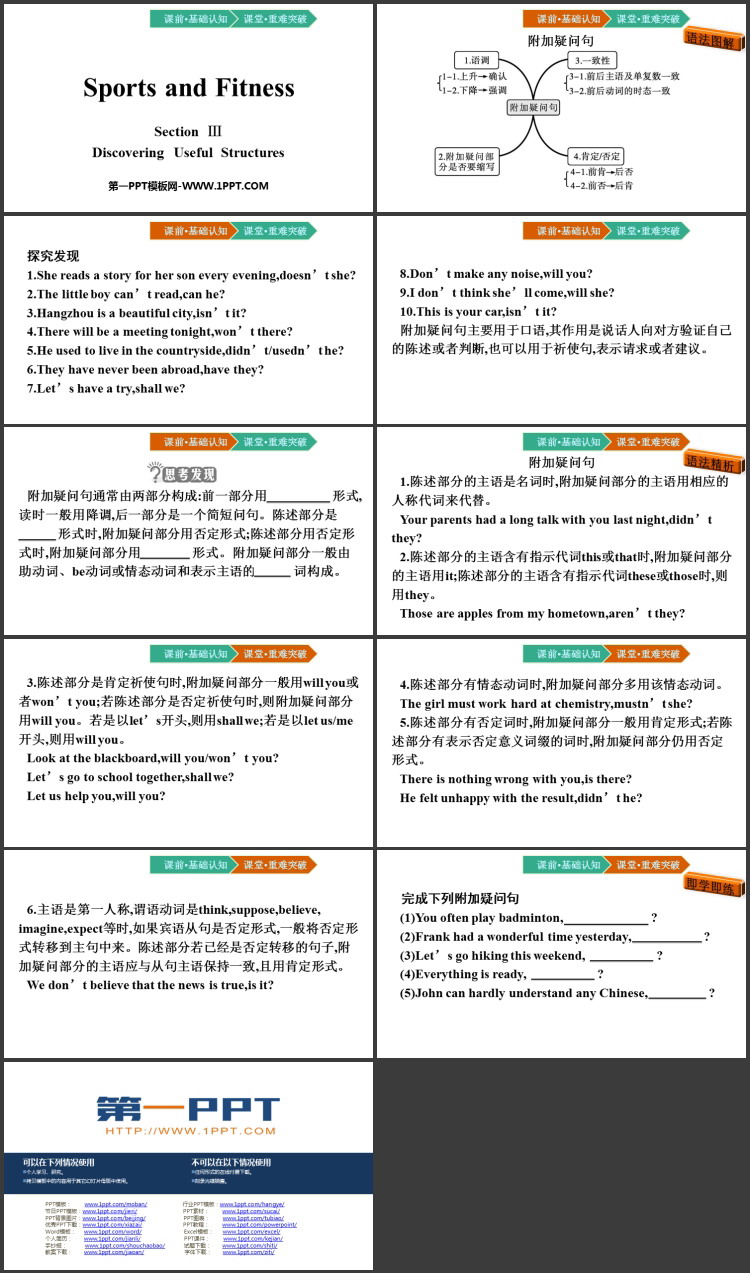
本课件聚焦人教版高中英语必修一《Sports and Fitness》SectionⅢ,系统讲解附加疑问句的构成与用法。通过10个经典例句和5条实用规则,帮助学习者快速掌握这一语法要点,提升口语表达准确性。
探究发现
1. She reads a story for her son every evening, doesn't she?
2. The little boy can't read, can he?
3. Hangzhou is a beautiful city, isn't it?
4. There will be a meeting tonight, won't there?
5. He used to live in the countryside, didn't/usedn't he?
6. They have never been abroad, have they?
7. Let's have a try, shall we?
8. Don't make any noise, will you?
9. I don't think she'll come, will she?
10. This is your car, isn't it?
附加疑问句主要用于口语,其作用是说话人向对方验证自己的陈述或者判断,也可以用于祈使句,表示请求或者建议。
附加疑问句
1. 陈述部分的主语是名词时,附加疑问部分的主语用相应的人称代词来代替。例如:Your parents had a long talk with you last night, didn't they?
2. 陈述部分的主语含有指示代词this或that时,附加疑问部分的主语用it;陈述部分的主语含有指示代词these或those时,则用they。例如:Those are apples from my hometown, aren't they?
3. 陈述部分是肯定祈使句时,附加疑问部分一般用will you或者won't you;若陈述部分是否定祈使句时,则附加疑问部分用will you。若是以let's开头,则用shall we;若是以let us/me开头,则用will you。例如:Look at the blackboard, will you/won't you? Let's go to school together, shall we? Let us help you, will you?
4. 陈述部分有情态动词时,附加疑问部分多用该情态动词。例如:The girl must work hard at chemistry, mustn't she?
5. 陈述部分有否定词时,附加疑问部分一般用肯定形式;若陈述部分有表示否定意义词缀的词时,附加疑问部分仍用否定形式。例如:There is nothing wrong with you, is there? He felt unhappy with the result, didn't he?